MORTALITY ANALYSIS OF PULMONARY TUBERCULOSIS IN ADULTS AGED 20 TO 59 YEARS: PRE- AND POST-PANDEMIC COMPARISON BY BRAZILIAN REGION
DOI:
https://doi.org/10.5327.prmj.596Keywords:
tuberculose respiratória, perfil epidemiológico, COVID-19Abstract
Introduction: Tuberculosis is an infectious disease caused by Mycobacterium tuberculosis, which, in its pulmonary form, primarily affects the respiratory tract.¹ Also known as Koch's Bacilli, these bacteria are highly resistant to antibiotics and have high virulence, triggering inflammatory reactions that can weaken the host's immune system.² During the COVID-19 pandemic, tuberculosis patient care was neglected due to the demands of coronavirus treatment, leading to a significant increase in TB-related mortality rates.³ Objectives: To describe pulmonary tuberculosis mortality rates before COVID-19 (2018-2019) and after it (2022-2023) across Brazilian regions, highlighting the states with the highest increases. Material and Methods: Data were collected from the DATASUS platform to analyze pulmonary tuberculosis mortality in patients aged 20 to 59 years, by Region/Federative Unit, using ICD-10 Group: Tuberculosis, ICD-10 Category: A15 Respiratory tuberculosis with bacteriological and histological confirmation, and Cause - ICD-BR-10: 005 Respiratory tuberculosis, for the period from 2018 to 2023.⁴ Results: Of the total deaths, 1,203 cases occurred pre-pandemic (2018-2019), 1,534 during the pandemic (2020-2021), and 2,105 post-pandemic (2022-2023), indicating an approximately 75% increase in mortality when comparing the pre- and post-COVID-19 periods (chart 1). The regions with the highest increases were the Southeast and Midwest, with percentages of 133% and 132%, respectively, followed by the South, North, and Northeast regions (chart 2). The federative units with the highest mortality rates were Rondônia, Paraíba, Piauí, Minas Gerais, and Espírito Santo, while those with the lowest increases were Pará, Bahia, Amapá, and Pernambuco, with the latter three showing a percentage decrease (chart 3). 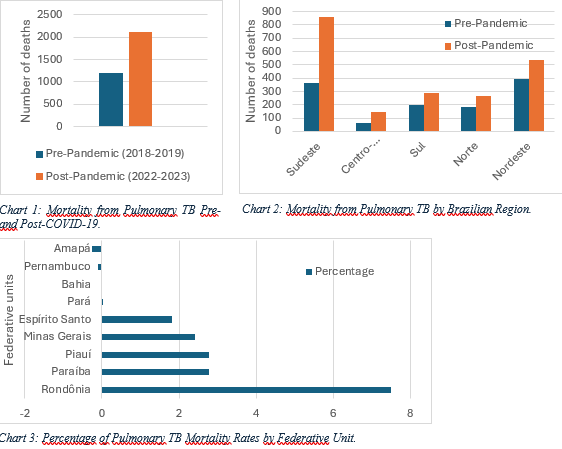 Conclusion: The data show a 75% increase in pulmonary TB mortality post-pandemic, with the greatest impact in economically developed regions. This rise may be linked to healthcare system overload, diagnostic delays, and treatment interruptions due to the prioritization of COVID-19. The variations between states reinforce the need for effective regional policies to meet population demands for treatment and mortality reduction. The decrease in some regions suggests specific health management characteristics, requiring further investigation.
Downloads
References
¹Luquetti CM, Cavalcanti MHR, Medrano TA, Foeger CM, Tenório DMC, Souza MB, et al. Tuberculose pulmonar em adultos: manifestações clínicas e complicações. Brazilian Journal of Implantology and Health Sciences 6 (8):5656-63.
²Ravagani AJ, Lopes L, Da Cruz PM, Bueno SM. DIAGNÓSTICO E TRATAMENTO DA TUBERCULOSE PULMONAR. Revista Corpus Hippocraticum, [S. l.], v. 2, n. 1, 2023.
³Cioboata R, Biciusca V, Olteanu M, Vasile CM. COVID-19 and Tuberculosis: Unveiling the Dual Threat and Shared Solutions Perspective. J. Clin. Med. 2023, 12, 4784.
⁴Ministério da Saúde (BR), DATASUS. Sistema de Informações sobre Mortalidade – SIM [Internet]. Brasília, DF: DATASUS; [citado em 2025 Mar 15]. Disponível em: http://tabnet.datasus.gov.br/cgi/tabcgi.exe?sim/cnv/obt10uf.def.